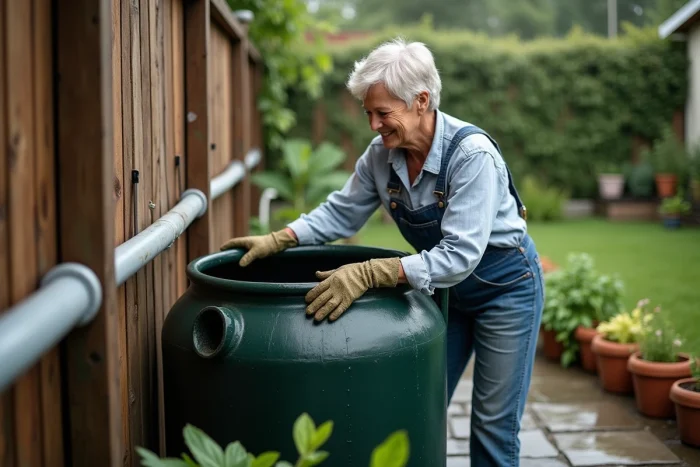
Collecting rainwater without a usable roof concerns an increasing number of French households: condominiums, houses without gutters, urban terraces without accessible downspouts. The topic goes beyond simple DIY tips. The quality of water collected on the ground differs radically from that captured from rooftops, and the solutions suitable for these configurations remain poorly documented in most available guides.
Quality of runoff water on the ground: a parameter often overlooked
The majority of articles on rainwater harvesting assume that the collected water will be used directly for irrigation. When collection occurs via a traditional roof, the risk of contamination remains moderate.
In dense urban environments, the situation changes as soon as water is collected from ground surfaces. Recent technical studies show that water collected from slabs, courtyards, or permeable parking lots contains more metals, hydrocarbons, and fine particles than water from inaccessible rooftops. This difference necessitates more thorough filtration before any use, including for watering vegetable plants.
In practical terms, a simple collector placed under a sloped tarp in a courtyard is not sufficient if that courtyard is regularly exposed to vehicle traffic or runoff from the road. At a minimum, a particle filter should be planned, or even a decanter for more ambitious installations.
Several collection solutions described as “roofless” in mainstream content overlook this quality constraint, which can pose problems for a vegetable garden or sensitive plants.
To delve deeper into the collection methods suitable for the absence of a roof, the guide from Le Jardinier Décorateur details several concrete configurations, from a stretched tarp to a butterfly system.

Sloped tarp and collection surface: sizing your installation without gutters
Without access to a roof, the collection surface becomes the limiting factor. The basic principle remains the same as with a roof: the larger the area exposed to rain, the greater the volume collected. The difference lies in the fact that you have to create this surface yourself.
Stretched tarp between two fixed points
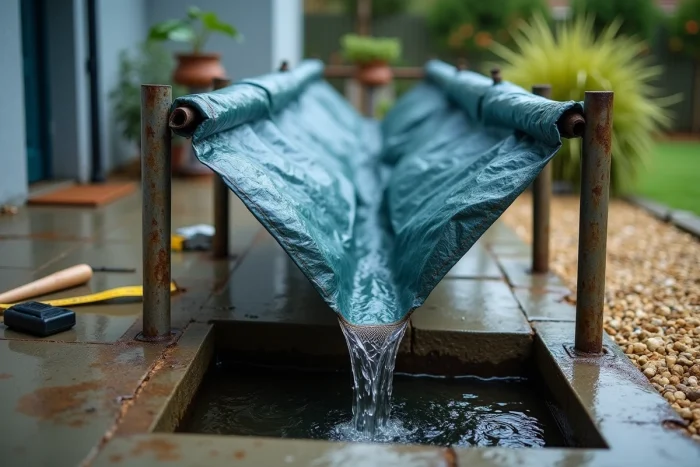
The polyethylene or PVC tarp stretched between a wall and a stake remains the most accessible solution. It works like a giant funnel that directs water to a low point connected to a tank. The weight of the tarp must be dense enough to withstand UV rays and weather conditions over several seasons.
A common mistake is to underestimate the slope. A slope that is too shallow causes water to stagnate, which deforms the tarp and encourages mosquito proliferation. Aim for a noticeable slope, visible to the eye, and check after each heavy rain that the water flows well toward the collection point.
Existing hard surfaces diverted
Terraces, parking slabs, concrete driveways: these surfaces already collect rainwater. The idea is to create a small ditch or channel that redirects runoff to a reservoir. The collection efficiency on hard surfaces often exceeds that of a tarp, because the surface is larger and already impermeable.
However, it is precisely on these surfaces that the quality issue mentioned earlier arises most acutely. A trade-off must be made between the volume collected and the level of filtration required.
Collective solutions in condominiums: shared tanks and communal awnings
For residents in apartment buildings, individual collection on a balcony remains anecdotal in volume. Recent feedback from social landlords and condominiums shows a different trend: rainwater harvesting without a roof is increasingly relying on collective solutions fed by common slabs, parking lots, or awnings.
These projects, documented in several reports from water agencies since 2022, have highlighted a measurable decrease in potable water consumption for watering shared green spaces. Another observed benefit: a reduction in conflicts within condominiums related to the management of charges and responsibilities.
The model relies on a large shared tank installed at the base of the building, fed by runoff from existing impermeable surfaces (parking lot, courtyard). A simple distribution system (tap or low-pressure pump) then serves the communal planters or green spaces.
- The initial investment is shared among co-owners, making the cost per household much lower than an individual installation.
- Maintenance (cleaning filters, winter draining) can be included in the property management contract or handled by a volunteer resident.
- The volume collected far exceeds what an individual balcony could capture, making the system relevant for watering substantial areas.
Filtration and maintenance: what changes when the water does not come from the roof
In a standard installation connected to a gutter, a standard filtering collector is usually sufficient to catch leaves and debris. Without a roof, the level of filtration must be raised a notch.
Compact urban devices (flexible tanks, storage columns, wall modules) rarely include a filtration system suitable for ground runoff. A pre-filter often needs to be added upstream of the tank. A fine mesh filter retains coarse particles, but for dissolved pollutants (metals, light hydrocarbons), only an activated carbon filter or passage through a filtering substrate provides a significant improvement.
Maintenance follows a different logic than that of a rooftop collector:
- The cleaning of the pre-filter must be more frequent, especially after storm events that carry more sediments.
- The tank requires a complete draining at least once a year to remove deposits that accumulate faster than with rooftop water.
- In winter, protection against freezing remains the same: partially empty the tank or install an antifreeze float.
- A regular visual check of the color and smell of the stored water allows for the detection of contamination before it becomes problematic.
Recent regulatory constraints on rainwater harvesting in individual housing, including without a usable roof, remain poorly detailed in the available online content. The available data does not allow for conclusions about the existence of a specific framework distinct from the decree regulating the domestic use of rainwater in general. Before starting a ground collection project, checking with the town hall for any local restrictions remains the most reliable precaution.