The maintenance of a home goes beyond vacuuming and arranging the sofa cushions. Behind everyday actions lie choices that influence the quality of the air we breathe, the durability of surfaces, and even the health of the occupants. In recent years, data on indoor pollution and the composition of household products have shaken up well-established habits.
Indoor air quality and maintenance: what sprays really change
The recommendations from Santé publique France and the Observatory of indoor air quality highlight a paradox: some cleaning actions degrade the air they are supposed to purify. Multi-purpose sprays, air fresheners, and deodorizers release volatile organic compounds (VOCs) that accumulate in enclosed spaces.
Daily ventilation, at least ten minutes with windows open, remains the most effective measure to lower pollutant concentration. Field reports vary on this point: in a home facing a busy road, opening during peak hours can bring in other pollutants. There is no universal rule, but the principle of air renewal remains valid in the vast majority of cases.
Reducing emission sources is as important as ventilating. Replacing a spray with a liquid cleaner applied with a cloth divides the dispersion of microdroplets in the air. Asthmatic or allergic individuals often notice a significant improvement simply by removing aerosols from their cleaning routine.
The resources dedicated to the home on Oh Brico detail concrete approaches to adapt your interior without multiplying chemical products.
Household products without PFAS and European eco-label: a sorting that is worth it
PFAS, these per- and polyfluoroalkyl substances nicknamed “forever pollutants,” are found in some cleaners, stain treatments, and water repellents for upholstery fabrics. ADEME has been promoting cleaners bearing the European Eco-label since 2023-2024, whose criteria exclude the most concerning substances and limit poorly biodegradable surfactants.
In practice, an eco-labeled product is not necessarily less effective. The criteria of the European Eco-label for multi-purpose detergents and floor cleaners impose performance thresholds tested in laboratories. The European Commission regularly updates these references.
Identifying a reliable cleaner on the shelf
- Check for the presence of the European Eco-label logo (the flower with twelve stars) on the packaging, the only official label harmonized at the European Union level for this category
- Avoid products mentioning fluorinated compounds in the INCI list, even in low concentrations, because PFAS do not degrade in the domestic environment
- Prefer concentrated formats to dilute, which reduce plastic packaging and the amount of surfactants dispersed per use
The available data do not allow us to conclude that all “green” or “natural” products without an official eco-label meet the same requirements. The absence of a strict regulatory framework on these marketing claims leaves a wide margin for interpretation for manufacturers.
Everyday surfaces and materials: adapting the action to what is being cleaned
A quartz countertop does not react like terracotta tiles. An oiled parquet floor cannot withstand the same detergents as a laminate floor. Most visible damage to indoor surfaces comes from an ill-suited product rather than a lack of cleaning.
Porous surfaces absorb acidic products, which causes irreversible stains on natural stone, waxed concrete, or marble. White vinegar, often presented as a universal solution, attacks the limestone present in these materials. On these surfaces, a neutral pH soap diluted in warm water is sufficient for regular maintenance.
Case of tile joints and mold in a damp room
Bathroom joints blacken due to the combined effect of residual humidity and insufficient ventilation. Scrubbing does not solve anything if the cause persists. Before treating the joints, it is necessary to check the extraction rate of the mechanical ventilation system or, if not possible, create a draft after each shower.
A silicone joint that has been moldy for several months is replaced more than it is cleaned. Removing it with a blade and replacing it costs little in materials and avoids the repeated use of chlorinated products, which themselves emit VOCs.

Transforming an interior without major renovations: high-impact visual levers
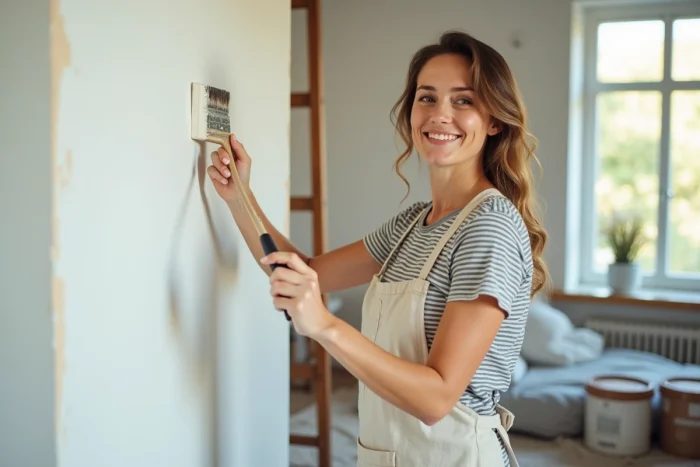
Repainting an accent wall, changing kitchen cabinet handles, replacing a central light fixture with several indirect sources: these interventions change the perception of a space without altering the structure. The cost-to-visual result ratio clearly favors these micro-transformations.
- A wall painted in a bold shade (sage green, duck blue, terracotta) transforms a room in half a day and requires only a pot of paint, a roller, and masking tape
- Textiles (curtains, cushions, rugs) modify the acoustics as much as the visual ambiance, which is particularly important in open spaces with hard floors
- Replacing a single ceiling light with two or three table lamps creates distinct usage areas in the same living room, without drilling or pulling extra cables
A common mistake is to accumulate small decorative changes without a coherent palette. Choosing a maximum of three shades for the entire room (walls, textiles, accessories) yields a more structured result than ten scattered additions.
Maintenance of wooden furniture and finishes
Solid wood ages better when regularly nourished with an oil suitable for its type. A waxed piece of furniture should not be oiled, and vice versa: mixing the two finishes creates a sticky film that traps dust. Identifying the existing finish before intervening prevents degrading a piece of furniture while trying to protect it.
Maintaining a home benefits from being thought of as a set of technical choices rather than an accumulation of chores. Each surface, each product, each action has a measurable impact on the durability of the interior and the air we breathe. Starting by eliminating what is harmful (sprays, unsuitable products, untreated humidity) often yields more results than adding yet another tip to your routine.