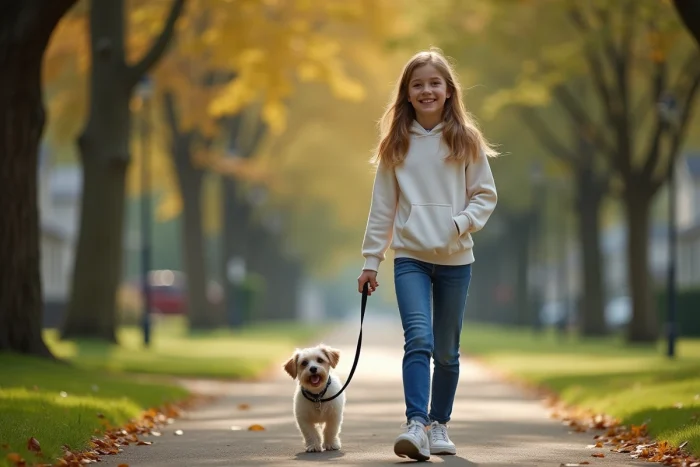
In France, the legal age to work is set at 16, but the law allows for light jobs from the age of 14 under strict conditions. However, many 15-year-olds engage in pet sitting, often without supervision or a defined status. Matching platforms generally impose a minimum age, but some families prefer to entrust their pets to young neighbors, thus circumventing official rules.
This unclear framework raises questions about the steps to take, the skills to acquire, and the precautions to consider when starting in this sector at 15.
At 15, what opportunities are there to start pet sitting?
At 15, young people who want to start pet sitting face a restrictive legal framework, but there are tips to carve out a place for themselves. Families with a dog, cat, or NAC (new pet) rely on proximity and reliability. Pet sitting then comes into play through word of mouth, local ads in shops, and neighborhood networks. It is often the choice for a holiday job or weekend work, easily accessible for occasional tasks that reassure everyone.
The key is trust. Clearly announcing availability, seeking parental consent, outlining accepted tasks, walks, visits, simple care—these all matter. Presenting oneself as attentive, reliable, and caring about animal welfare makes all the difference. Families appreciate young people who commit over time, especially when it comes to animals that require daily attention or repeated visits.
For those looking for how to become a pet sitter at 15, a few good practices open doors: obtaining written parental permission, exchanging emergency numbers with pet owners, and keeping a log of care and meals. Official platforms do not accept those under 16, but the trust of a neighbor or acquaintance can be earned from adolescence by proving that one takes the job seriously. Opportunities quickly diversify: cat sitting for occasional absences, dog sitting for regular walks. This is how a solid first experience is built, recognized by the entire neighborhood.
The steps and training to know before starting
Before caring for the first animal, it is essential to check on civil liability. At 15, one must ask their parents if their insurance covers the activity of pet sitting. This precaution, often overlooked, protects in case of issues or accidents and reassures pet owners. Trust is also built on such administrative details.
French law does not require a certificate of competence or ACACED to care for an animal between individuals, as long as the activity is not professional. The statuses of micro-entrepreneur or auto-entrepreneur are reserved for adults or emancipated minors, which excludes 15-year-olds. At this age, pet care must therefore remain occasional, within a family or friendly framework, without massive advertising or legal status.
To gain confidence, it is useful to learn the basics of animal behavior, stress signals, and the specific needs of dogs, cats, and NAC. There are free guides, educational videos, and fact sheets created by veterinarians or shelters. Learning first aid techniques or dog training gives a real advantage. At 15, one learns mainly by observing, discussing with experienced adults, and training on the ground.
Organizations like the DDPP (Departmental Directorate for the Protection of Populations) or the DDCSPP (Departmental Directorate for Social Cohesion and Protection of Populations) regularly share recommendations. Taking the time to inform oneself with them helps better understand the limits of amateur pet sitting and the rights of minors. Putting agreements made with families in writing clarifies expectations and secures everyone’s commitment.
Practical tips and tricks for successful first pet sitting jobs
At 15, reliability cannot be improvised. To stand out to pet owners, one must focus on rigor. A notebook, where habits, treatments, feeding instructions, and emergency contact numbers are noted, quickly becomes essential. During the first contact, it is important to be curious and precise: ask how the animal behaves, what it likes or fears, how walks go, and what games elicit a reaction. These details reassure and show that one takes animal welfare very seriously.
It is precisely the small attentions that make the difference. Arriving on time, respecting what has been agreed upon, adapting to each family’s needs—this is what pet owners expect. A daily report, sometimes with a photo sent to the owner, creates a climate of trust and encourages the desire to renew the experience. To gain visibility, it is possible to communicate locally, for example through social networks, without ever revealing the identities of clients or their pets.
Here are some concrete ideas to enrich one’s practice:
- Read books on dog training or animal first aid to better anticipate tricky situations.
- Observe the actions of veterinarians or volunteer workers to understand best practices and appropriate postures.
- Be attentive to signs of discomfort in domestic animals: isolation, loss of appetite, unusual agitation should raise alarms.
For the first missions, it is preferable to start with home visits or walks close to home, adapted to the school schedule. This gradual method allows for gaining experience while ensuring the safety of the entrusted pets.
At 15, taking care of neighborhood animals is learning responsibility at a child’s level while building trust that sometimes lasts much longer than a summer.