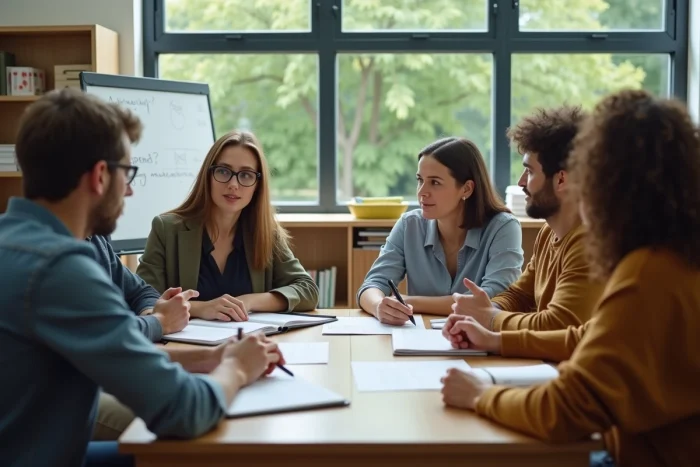
In France, the evaluation of beginner teachers often overlooks the reality of each discipline, despite the displayed guidelines. Elsewhere, some countries opt for a one-size-fits-all training approach, while others immediately confront future teachers with classroom life. The dilemma between imparting disciplinary knowledge and supporting students in their learning still divides educational teams. Researchers in educational sciences emphasize the need to clarify these practices to make teaching more powerful and fair.
Didactics and pedagogy: what are the differences and why is it important to distinguish them?
In the educational lexicon, two notions intertwine without ever merging: didactics and pedagogy. Didactics questions the nature of knowledge, organizes it, and outlines the precise paths of learning in each discipline. Pedagogy, on the other hand, inhabits the classroom: managing the group, climate, adapting to students, and maintaining a constant dialogue with their needs and rhythms.
Mastering the didactic and pedagogical approach offers the possibility to go beyond simple frontal transmission. Didactics establishes solid benchmarks, gives meaning to each progression, connects content, and makes the disciplinary logic readable. Pedagogy brings flexibility: choosing methods, paying attention to differences, creating a conducive space for engagement.
In daily reality, this distinction is not a theoretical detail. It allows for constant adjustment: teaching is about daily composition with these two poles. Research confirms: their articulation nourishes the learning dynamic where opposition sterilizes. This movement gives full strength to the profession, session after session.
Concretely, it involves varying one’s levers according to the encountered situation:
- Didactics: structuring knowledge, prior analysis of obstacles and typical errors.
- Pedagogy: arranging interactions, choosing devices to energize the group and individualize paths.
Clarifying one’s professional stance means refusing to be just a simple transmitter. Teaching requires dialoguing content, methods, and attention to the student. Advancing along this ridge line gives depth to classroom practice.
Overview of essential pedagogical methods to better support learners
Multiplying pedagogical methods opens the door wide to diversified learning. Each teacher draws from their palette of tools, adapting and modulating according to the group, the discipline, and the learning objectives. The expository method, whether a lecture or structured presentation, lays the foundations and provides a clear framework. To truly anchor knowledge, it needs to be associated with other approaches.
The interrogative method places reflection at the heart of exchanges: the teacher questions, engages, and supports the student in making sense. Questions open the debate and allow students to articulate and clarify their representations. The demonstrative method focuses on the concrete: showing a gesture, presenting a procedure in the lab, breaking down a process, making visible to make understood.
To engage even more, active methods and the experiential method place the student in action, inviting them to experiment, collaborate, and solve new problems. This involves workshops, role-playing, case studies, but also support documents designed to guide this journey. A solid pedagogical document serves as a thread and gives coherence to the whole.
As an illustration, here are some ways to assess progress throughout the journey:
- Repeated practical exercises to firmly establish knowledge,
- Self-assessments: an opportunity to reflect on one’s own progress,
- Individualized feedback to guide each person where they can improve.
Evaluation then ceases to be a fixed moment: it becomes a driver of evolution, a field of encouragement, a tool of trust for each student.
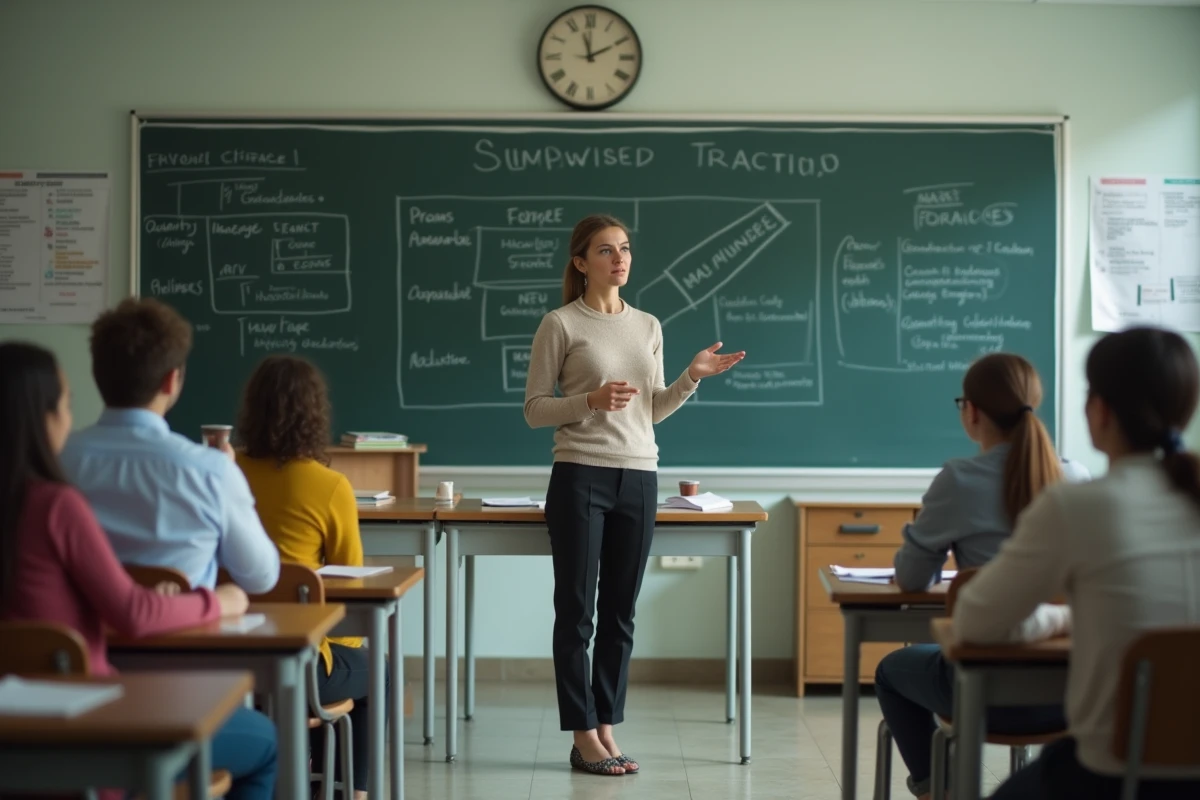
Cultivating teaching skills: why continuous training makes a difference
In a profession where everything evolves—programs, tools, audiences—refusing stagnation is a given. Questioning oneself, learning, renewing practices: this is the living material of continuous training, which nurtures curiosity, sparks new ideas, and strengthens pedagogical engineering over the years.
Regular training is not limited to a technical update. It is a whole process of transforming one’s perspective, questioning methods, and concretely adapting to new challenges. Three axes often emerge in this dynamic:
- Acquiring additional skills to diversify support,
- Integrating innovative pedagogical tools to energize classroom work,
- Rethinking choices in light of the transformations in teaching.
Professional training allows for sharing, questioning, and confronting ideas with other teachers. Joining a specialized program opens the door to new practices, provides perspective, and strengthens effectiveness day by day. This collective dynamic breaks isolation and injects new momentum into the profession.
Continuous training also contributes to greater equity: everyone can adjust their practices, respond appropriately to their students’ expectations, and anticipate the transformations at work in education. From the choice of methods to the design of a course, from individualized follow-up to final evaluation, each step of the learning process gains in consistency. Refusing to settle into habit means betting on success, for oneself and for each learner.
Teaching? It is never about rolling out a single model. It is about adjusting tirelessly, refining strategies, welcoming uncertainty, and bouncing back, session after session, where students surprise us.