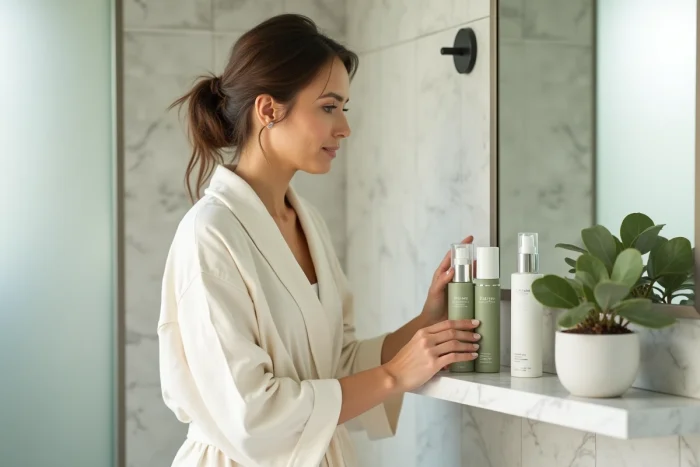
Building a beauty routine that stands the test of time requires sorting through dozens of launches each season. Multi-use products, skin microbiome-focused treatments, formulas with claims now regulated by European law: the selection criteria have changed. This article compares the categories of products that make up an effective routine and identifies those that truly deserve a place in the bathroom.
Multi-use products vs. five-step routine: what minimalism changes
The trend towards skin minimalism, documented in the NellyRodi x FEBEA “Beauty Trends 2025” report published in October 2024, shows a clear increase in demand for shorter routines, particularly among 25-40 year-olds. Systematic layering is declining in favor of what the report calls “essential beauty.”
Specifically, moving from five products to two or three well-chosen ones reduces the monthly budget and limits the risks of interactions between active ingredients. A tinted moisturizer that replaces both day cream and foundation covers two steps in one application. A pigmented lip balm avoids the need to carry a lipstick in addition to a lip treatment.
To navigate among these products, the shopping selection from Conseils Beauté groups references by usage, making it easier to sort between versatile formulas and those with a single function.
Microbiome-friendly face care: reading beyond the packaging
So-called “microbiome-friendly” treatments form an expanding category. Their principle: to preserve or strengthen the skin’s natural bacterial flora instead of stripping it with harsh surfactants. The formulas include prebiotics (fibers that nourish good bacteria) or postbiotics (metabolites from fermentation).
A microbiome-friendly treatment is not a “preservative-free” treatment. Confusion is common. These products contain preservatives but avoid agents that disrupt the skin flora, such as certain sulfates or certain denatured alcohols in high concentrations.
Concrete selection criteria for a face treatment
- The INCI list mentions an identifiable prebiotic (inulin, alpha-glucan oligosaccharide) or a postbiotic (lactobacillus ferment filtrate).
- The cleanser has a pH close to that of the skin, around 5.5, to avoid disrupting the acid barrier.
- The product does not simultaneously claim to be “antibacterial” and “microbiome-friendly,” two contradictory promises.
Checking these points takes a few seconds in front of the label and eliminates the majority of products that ride the term without respecting its principle.
“Clean” and “natural” claims: the regulatory framework tightens
The European directive on environmental claims (Green Claims Directive), whose proposal was published by the European Commission in 2023, prohibits vague mentions such as “eco-friendly” or “climate neutral” without verifiable evidence. Its transposition into member states is underway.
For a consumer, the direct consequence is simple: products that display “clean beauty” or “natural” without third-party certification (Ecocert, Cosmos, Natrue) will have to provide detailed justifications or remove these mentions. While waiting for full implementation, reading the technical file or product sheet on the brand’s website remains the most reliable reflex.
What the “without” mention means (and does not mean)
“Paraben-free,” “silicone-free,” “sulfate-free”: these formulations do not guarantee that a product is gentler or more effective. A sulfate-free shampoo may contain another irritating surfactant. The absence of an ingredient says nothing about the quality of those that replace it.
The only reliable indicator remains the complete composition. Label scanning apps (INCI Beauty, Yuka) provide a first filter, but they do not measure effectiveness or individual tolerance.
Makeup, lips, body: categories where the value for money varies the most
Not all beauty product categories justify the same investment. The table below compares three major components of a routine (face care, makeup, body care) based on the criteria that matter when shopping.
| Category | Average usage duration | Priority criterion | Common pitfall |
|---|---|---|---|
| Face care (creams, serums) | Several weeks to a few months | Compatibility with skin type | Multiplying concentrated actives (retinol + acids + vitamin C the same night) |
| Makeup (foundation, lips) | Several months | Wear and texture suited to skin tone | Choosing a foundation online without testing the shade |
| Body care (lotions, oils, scrubs) | Several weeks | Value for money | Paying for premium packaging for a basic formula |
Face care is the area where a mistake costs the most, because an unsuitable product can cause skin reactions that then require corrective treatments. In contrast, for body care, the formulation differences between entry-level and high-end products are often minimal for classic moisturizing lotions.
Hair and accessories: two underestimated budget lines
Hair care represents a regular expense that many neglect in their beauty budget. A conditioner suited to hair porosity does more than any mask applied once a month.
Accessories (brushes, sponges, brushes) wear out and become contaminated. Replacing a makeup sponge every three months limits bacterial proliferation, a point rarely mentioned in favorite lists.
Building a successful beauty routine relies less on the number of products than on the coherence among them. The NellyRodi x FEBEA report confirms this shift towards tighter selections. Checking compositions, being wary of uncertified claims, and allocating the budget where the qualitative gap is real: these three reflexes change the skin more than yet another trendy serum.