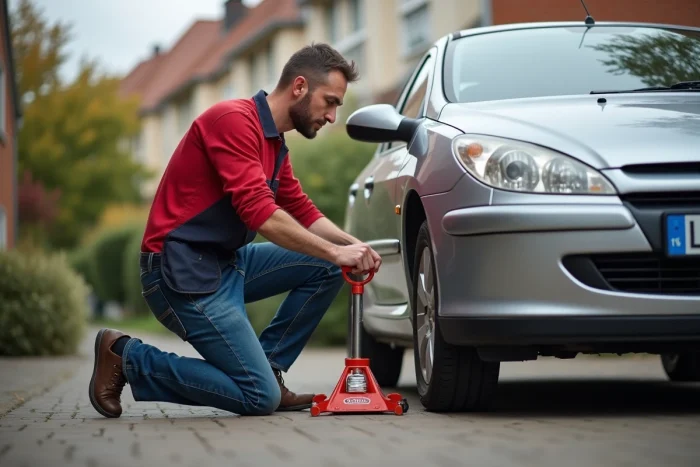
A poorly positioned jack on a Peugeot 307 can turn a simple operation into a forceful struggle: damaged floor, deformed sill, compromised safety. The visible markers under the car do not always guarantee a hassle-free lift, and depending on the year of manufacture, the tolerances of the bodywork can sometimes vary from one model to another.
Some owners bitterly experience this: placing the jack under the door sill without thinking, and there goes the metal bending. It can sometimes be difficult to figure it out, as the user manuals differ on the exact location of the Peugeot lifting points. Attention to detail makes all the difference.
Identifying specific lifting points on a Peugeot 307: what you need to know
On a Peugeot 307, nothing is left to chance regarding the jack’s location. The manufacturer has defined specific lifting points, designed to preserve the vehicle’s structure and ensure user safety. These areas, located near each wheel under the sill, can be recognized by a raised marker or a notch under the body. A glance at the technical manual can help locate them, but nothing replaces a direct inspection under the car before acting.
The monoblock screw jack, supplied as standard with most versions of the Peugeot 307, must be positioned on these markers. For those with a hydraulic jack, the principle remains the same: never improvise the support point. As for the storage of the jack, it varies by version, whether in the trunk, rear compartment, or a specific compartment at the back.
To visualize each step and locate the correct position under the chassis, the method ‘how to place a jack according to Must Car’ details the gesture to adopt. Straying from these markers can lead to irreversible damage to the structure or make the maneuver hazardous. By following the Peugeot technical manual and the manufacturer’s instructions, any risk of unexpected sagging or deformation is eliminated.
Why safety must come first before any jack operation?
Before touching the jack or approaching your Peugeot 307, there is a rule that leaves no room for compromise: safety comes first. Lifting a car, even for a simple tire change, involves ensuring the vehicle’s stability and avoiding any danger to oneself and those who might be nearby. A poorly executed gesture, and everything can go wrong.
The vehicle must rest on a flat and stable surface, with no exceptions. Even for a quick operation, a poorly positioned Peugeot 307 can tip over. Always engage the handbrake and block the opposite wheels to prevent any movement. These simple actions ensure that the vehicle won’t budge an inch.
To enhance safety, it is imperative to use a jack stand in addition to the jack. It is strongly advised not to leave the car resting solely on the jack during the operation. Once the 307 is lifted, placing the jack stand under the lifting point maintains stability and protects against any unexpected sagging.
Here are some essential recommendations to follow for every operation:
- Always use the jack with the appropriate accessories (jack stands, wedges, etc.).
- Strictly follow the manufacturer’s instructions for each lifting operation.
- Never position yourself under the car while it is only supported by the jack.
Applying these guidelines means eliminating improvisation and ensuring that every intervention takes place under the best conditions, without unnecessary risk.
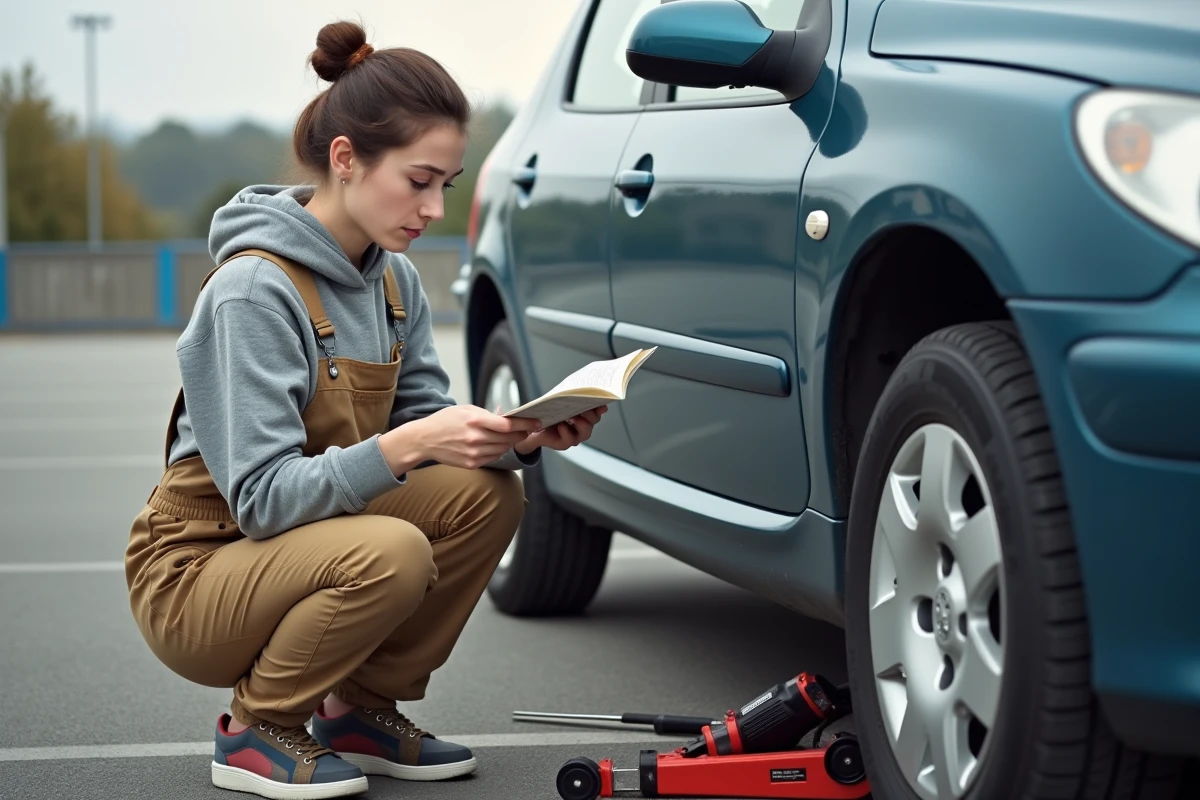
Detailed steps for correctly placing a jack on your Peugeot 307
Before tackling any screws, start by identifying the type of jack available. Most Peugeot 307s come with a monoblock screw jack, but some newer or better-equipped models offer a hydraulic jack. The robustness of the hydraulic model is appealing due to its lifting capacity, but the screw jack provides the essentials for everyday operations.
Next, locate the lifting point. On the 307, it is a marker located near each wheel, just under the sill. This symbol, sometimes discreet, is engraved in the metal and indicates the exact location to prioritize to avoid any deformation. A glance at the technical manual from the manufacturer clarifies the necessary lifting capacity and specifies the jack’s positioning.
Then, prepare the work area. Position the Peugeot on a flat surface, engage the handbrake, and block the wheels on the opposite axle. Place the jack precisely under the marker and check that its head fits the shape of the lifting point. For the screw jack, insert the handle and turn gently. With a hydraulic jack, operate the lever with slow and wide movements.
Never rely on luck with your equipment. The lifting capacity of the jack must always exceed the weight you intend to lift, which is at least one side of the car. For hydraulic jack users, an annual check is essential: oil level, leak detection, piston verification. This routine prolongs the tool’s reliability and ensures constant safety, regardless of the circumstances.
When facing a Peugeot 307, the right gesture in the right place with the right tool makes the difference between a smooth repair and a hassle that leaves marks. It is up to everyone to avoid missteps, so lifting their car remains a safe, precise act, and without unpleasant surprises.