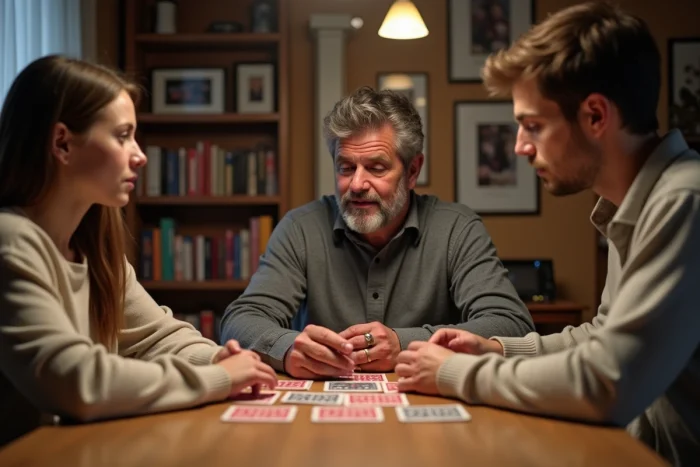
Statistically, no combination guarantees victory in 7 14 21. Yet, around the table, some swear by their methods. There are talks of “flaws” to exploit or optimized rounds, but the reality often lies in the flexibility of the rules, which vary from group to group. The probabilities change with usage, and each game opens the door to new surprises.
Strategies, sometimes passed down from player to player, rely on observing others, managing risk, or precisely choosing the moment to bet. Behind the facade of chance, anticipation and caution become discreet but formidable weapons.
The game 7 14 21: between chance, strategy, and conviviality
The game 7 14 21 has lost none of its popularity. Unifying and accessible to all, it brings together both children and parents around a table, challenging them to reach exactly 7, 14, or 21 points without exceeding. On the surface, the rule seems simple, but each card drawn brings its share of uncertainty. The Ace perfectly illustrates this blur: it can be worth 1 or 11 points, and change the outcome of a round in a flash, disrupting all calculations.
Regional variants add their spices to the game. Adding a wild card, changing the way to count, or integrating different challenges, each modification transforms the dynamics of a game. The pleasure arises as much from these adjustments as from the tension between chance and mastery, all while maintaining this convivial ritual where laughter often pierces through strategic discussions.
Everyone relies on common benchmarks, this flexible framework without which the pleasure of playing dissipates. To ensure smooth and enjoyable games for all, it is first necessary to master the rules of the game 7 14 21 as adopted by the group. This shared foundation allows everyone to refine their choices, balancing between boldness, bluff, and caution.
What rules to master to avoid common mistakes?
It’s impossible to aspire to the podiums without knowing by heart how to count points. Face cards, kings, queens, and jacks are worth 10 points. The Ace, the chameleon of the game, is worth 1 or 11 points depending on the player’s hand. A mistake on this point leads to immediate consequences, sometimes even a temporary sidelining in case of exceeding.
Over time, each group develops its habits, introducing a challenge rule here, an additional wild card there. Before the cards fly, it’s always better to clarify the version that applies to cut short misunderstandings and adjustments at the end of the round.
Experienced players scrutinize the state of the deck, monitor who is approaching the fateful score, and look for opportunities to subtly influence the game. Reading silences, observing hesitations: these are often the signals that reveal the most, far more than a calculation announced aloud or a card played with confidence.
Here are the main precautions to keep in mind to avoid classic blunders:
- Always pay attention to the actual value of each card: no approximations, a distraction costs you immediately.
- Before the first deal, clearly establish the variant chosen by the group to avoid pointless debates at the end of the round.
- Keep an eye on the game and each player’s scores; vigilance makes the difference.
- Never approach the line of 7, 14, or 21 without calculation: crossing the threshold almost always leads to a penalty.
From there, everything becomes possible: measured risk-taking, quick calculations, false hesitations, and well-placed bluffs. The game gains flavor, and everyone, novice or veteran, can find their way without feeling cheated.

Practical tips and resources for playing smart… without forgetting the risks
From the very first hand, it’s hard not to feel the tension rise. Managing points, mentally counting what remains in the deck, identifying which Ace might still come up or who has already approached victory: strategy makes all the difference here.
Careful calculation reduces the risk of missteps. The habit of following the game, anticipating the next draw, or pretending to be indecisive are all ways to turn a given game around for the worse. But the talent of a good player also lies in their ability to remain flexible: adapting to others, sensing the atmosphere, choosing to change the pace from one round to the next, is often what makes the difference at the table.
Specialized sites detail pro tips, original variants, or advice for organizing an unforgettable evening. Drawing a few ideas, crossing tips, and sharing past experiences are all levers to enrich the experience and personalize the rules, without ever freezing anything in stone.
However, the temptation to win at all costs sometimes leads to a dead end: too much confidence, the desire to shine, or the pressure of others’ gazes can lead to avoidable mistakes. Knowing how to remain in control, not succumbing to the euphoria or stress of the last round, is where the true spirit of the game reveals itself.
After all, 7 14 21 promises no guaranteed victory, but it invariably offers moments of tension, humor, and suspense at the table. And when the last card is about to fall, every player watches for that tiny gap where everything can tip.